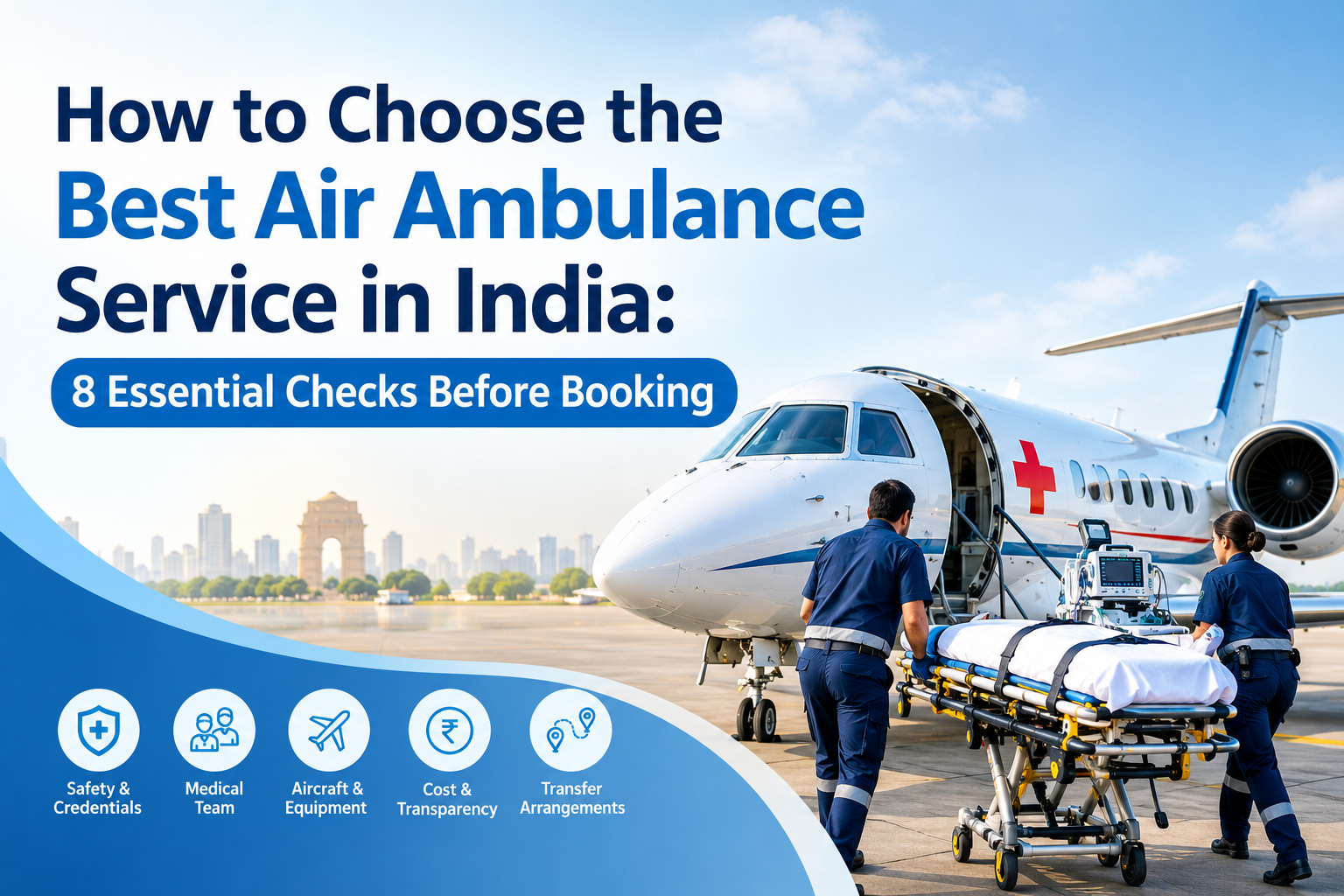
When a patient needs urgent medical transportation, choosing the right air ambulance service in India can be a critical decision for the family. Whether the patient requires an ICU-equipped aircraft, an intercity medical transfer, or international medical repatriation, the service must match the patient's medical needs and travel requirements.
However, not every air ambulance provider offers the same aircraft, medical team, equipment or transfer arrangements. Comparing quotations without understanding what is included can also lead to unexpected costs and delays.
Before booking an air ambulance in India, families should evaluate the medical arrangements, aviation operator, equipment, transfer process and total cost.
Here are eight essential checks to help you make a more informed decision and arrange an appropriate medical transfer.
1. Verify the Aircraft Operator and Aviation Credentials
One of the first steps when choosing an air ambulance company in India is understanding who will operate the aircraft.
Some companies operate aircraft directly, while others coordinate flights through third-party aviation operators. This distinction matters because the organisation coordinating the medical transfer and the operator responsible for the aircraft may be different.
Before confirming your booking, ask:
-
Which aviation operator will conduct the flight?
-
What aircraft is being proposed for the transfer?
-
Can the relevant operating credentials be verified?
-
Is the aircraft suitable for the proposed route and patient requirements?
-
Who is responsible for flight coordination and operational updates?
Verify applicable aviation approvals with the relevant authority where possible. Do not rely solely on website claims, promotional material or verbal assurances.
A transparent provider should clearly explain the proposed arrangement before you make a payment.
2. Check the Medical Team's Experience
An air ambulance is not simply an aircraft with a patient on board. Medical support must be appropriate for the patient's condition throughout the journey.
Depending on the case, the transfer may require a critical-care doctor, nurse, paramedic or a combination of qualified medical professionals.
Ask the provider:
-
Who will accompany the patient?
-
What experience does the team have with the patient's condition?
-
Will the medical team be available throughout the flight?
-
Who determines the patient's fitness for transfer?
-
What arrangements are in place if the patient's condition changes during transportation?
For patients requiring intensive care, the medical team should be selected according to the patient's clinical needs rather than using the same staffing arrangement for every case.
The treating doctor and the medical transport team should review the patient's condition before finalising the transfer plan.
3. Confirm the Aircraft Has the Required Medical Equipment
The right equipment depends on the patient's diagnosis, stability and level of support required during the flight.
An ICU air ambulance may need equipment such as:
-
Transport ventilator
-
Multiparameter patient monitor
-
Oxygen supply
-
Infusion pumps
-
Suction equipment
-
Defibrillator
-
Emergency medication and airway equipment
Not every patient requires every item. The equipment list should be based on the patient's medical assessment.
Before booking an air ambulance with ICU facilities in India, ask the provider to confirm which equipment will be available for your specific case.
If the patient requires ventilator support, continuous oxygen, cardiac monitoring or specialised medication, disclose these needs during the initial enquiry.
The objective is to ensure that the medical team, aircraft and equipment are appropriate for the planned journey.
4. Compare the Total Air Ambulance Cost, Not Just the Starting Price
The cost of an air ambulance in India varies according to the route, aircraft, medical requirements and operational arrangements.
A quotation may change depending on:
-
Departure and destination cities
-
Flight distance and aircraft availability
-
Aircraft positioning requirements
-
Medical team composition
-
Ventilator, oxygen or other equipment requirements
-
Airport charges and permissions
-
Ground ambulance arrangements
-
Urgency and scheduling
-
International permits, where applicable
For this reason, an advertised starting price may not represent the total cost of the transfer.
Request a written quotation and check whether it includes the aircraft, medical team, required equipment, airport coordination and ground transportation at both ends.
Also clarify payment terms, cancellation conditions, possible additional charges and what happens if the flight is delayed or the patient's medical condition changes.
A clear, itemised quotation helps families compare providers on a like-for-like basis.
5. Confirm Bed-to-Bed Patient Transfer Arrangements
An important consideration when arranging an air ambulance service is how the patient will travel between the hospital and the aircraft.
A flight booking alone does not necessarily cover the complete journey.
Depending on the case, the transfer may involve:
-
Pickup from the current hospital.
-
Ground ambulance transportation to the departure airport.
-
Transfer to the aircraft with appropriate medical support.
-
In-flight medical supervision.
-
Arrival and coordination at the destination airport.
-
Ground ambulance transportation to the receiving hospital.
Ask whether the provider can coordinate a bed-to-bed air ambulance transfer and confirm which parts are included in the quotation.
The current hospital, receiving hospital, medical team and ground transport providers may all need to coordinate their schedules.
For international patient transfers, documentation, immigration procedures and destination arrangements may also need to be addressed in advance.
6. Ask Whether an Air Ambulance Is the Only Suitable Option
A dedicated air ambulance is not automatically necessary for every patient who needs medical transportation.
Depending on the patient's condition and medical clearance, alternatives may include a commercial airline stretcher or a commercial flight accompanied by a medical escort.
Dedicated air ambulance: May be appropriate when a patient requires a higher level of medical supervision, specialised equipment or a dedicated medical flight.
Commercial airline stretcher: May be considered for selected patients who meet the airline's medical and operational requirements.
Medical escort: May be suitable for some patients who can travel on a commercial flight with appropriate professional support.
Airline approval and medical clearance requirements vary. For example, Air India identifies MEDIF documentation, medical reports and additional requirements for certain cases involving stretchers, oxygen or medical equipment. Final travel authorisation depends on its assessment and approval process.
Ask the medical transport team to explain which options are appropriate for the patient's condition, including their limitations, costs and expected coordination time.
The decision should be based on medical suitability, not price alone.
7. Check Medical Clearance, Documentation and Scheduling
Medical transportation requires careful planning, especially when the patient is being transferred between cities or countries.
Depending on the case, the provider may request:
-
Patient's current medical summary
-
Recent investigation and treatment reports
-
Current medication list
-
Oxygen or ventilator requirements
-
Treating doctor's assessment
-
Patient identification and travel documents
-
Receiving hospital details
-
Medical clearance forms, where applicable
For international transfers, additional flight permissions, immigration documentation and receiving-hospital coordination may be necessary.
Ask who will coordinate these requirements, what information the family must provide and which approvals remain outstanding.
Do not assume that an aircraft can depart immediately after a quotation is accepted. Availability, medical suitability, weather, operational permissions and documentation can affect the schedule.
An experienced coordination team should explain the next steps and keep the family informed about confirmed arrangements.
8. Evaluate Communication, Transparency and Emergency Support
Families arranging a medical flight are often under considerable emotional pressure. Clear communication is therefore an essential part of the service.
Before booking, check whether the provider:
-
Responds clearly to medical and operational questions
-
Explains the proposed transfer without unrealistic promises
-
Provides a written quotation and scope of service
-
Identifies the aviation operator and medical arrangements
-
Explains documentation and approval requirements
-
Provides a clear point of contact for updates
-
Communicates changes to the schedule promptly
If the service advertises 24/7 assistance, confirm how to reach the coordination team outside normal business hours.
Be cautious of guaranteed departure times before required approvals, vague pricing, unclear medical staffing or pressure to make immediate payment without receiving the essential details.
Trustworthy communication helps families understand the process and make informed decisions during a difficult time.
Why Choose HumanCare Worldwide for Air Ambulance Coordination?
HumanCare Worldwide supports international medical transfer and medical repatriation coordination based on individual patient requirements.
Depending on the case, assistance may include air ambulance coordination, medical escort arrangements, commercial airline stretcher coordination, medical documentation and hospital-to-hospital transfer planning.
Every patient has different medical and travel requirements. The first step is to review the patient's current condition, location, destination and level of support required during transportation.
Before requesting a quotation, keep the latest medical summary available and confirm the departure and destination locations. This information helps the team assess the case and explain the available transfer options.
Need an Air Ambulance in India? Speak With a Medical Transfer Coordinator
Choosing an air ambulance provider requires more than comparing prices. The aircraft operator, medical team, equipment, transfer arrangements and total quotation should all be reviewed before booking.
If you need an air ambulance service in India, an ICU air ambulance, an intercity patient transfer or international medical repatriation, contact HumanCare Worldwide to discuss your requirements.
Share the patient's current location, destination city, medical condition and preferred transfer date. The team can review the information and explain the next steps for assessing a suitable medical transfer.
Contact HumanCare Worldwide for air ambulance and medical repatriation assistance at INDIA +91 9699999065